
Lenzing – Front-End Engineering Design Study
Lenzing - Establishing a Deliverable Cooling System Replacement Through FEED
Key Results
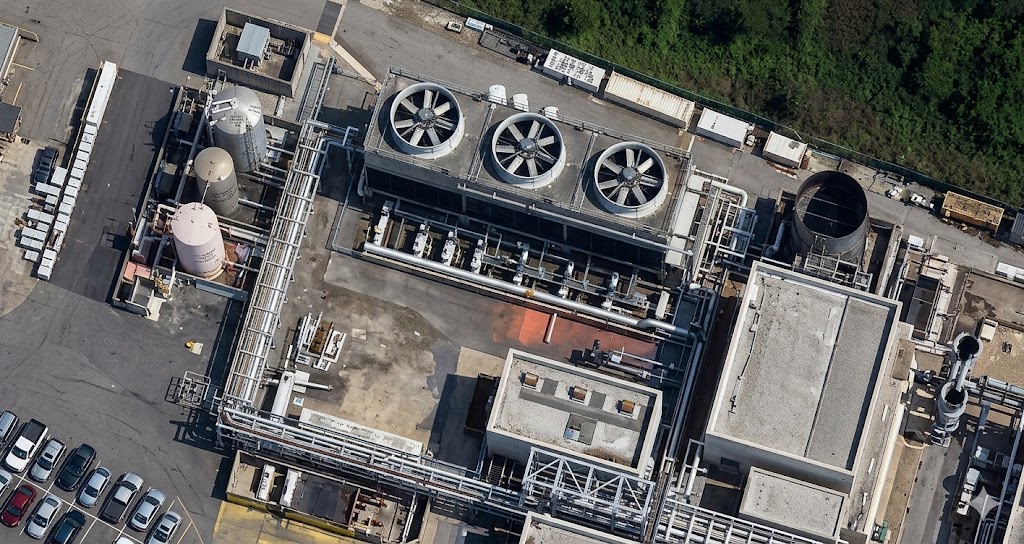
Lenzing identified that their existing cooling tower infrastructure was approaching the end of its operational life. The system was no longer operating at full performance, requiring increasing maintenance intervention, and presenting a growing risk to production continuity. A FEED study was undertaken to bring clarity to these questions before any capital commitment was made.
Context
Lenzing identified that their existing cooling tower infrastructure was approaching the end of its operational life.
The system was:
- No longer operating at full performance
- Requiring increasing maintenance intervention
- Presenting a growing risk to production continuity
Initial assessments also indicated that replacing the system within the existing footprint would be difficult to
achieve without significant disruption to operations.
The requirement was therefore broader than equipment replacement. The site needed to understand:
- What the future system needed to deliver
- How it could be implemented within a live environment
- What level of investment would be required
- What risks would need to be managed

Role of the FEED Study
A FEED study was undertaken to bring clarity to these questions before any capital commitment was made.
The objective was to develop a coordinated engineering position that would allow Lenzing to:
- Make an informed investment decision
- Understand how the project could be delivered in practice
- Reduce technical and commercial uncertainty
- Progress to procurement and construction with confidence
Engineering Approach
A structured approach was adopted, beginning with process definition and progressing through each engineering
discipline in sequence.
Each stage builds on the last, ensuring the final design is developed as a coordinated whole.
Process Definition
The starting point was to establish a clear and validated design basis.
This included:
- Heat rejection requirement of approximately 32 MW
- System flow rates of approximately 3,800 m³/h
- Verified operating temperatures and conditions
This stage defines what the system must achieve and underpins all subsequent design work.
Mechanical System Development
Based on the process requirements, the mechanical system was developed.
This included:
- Modular cooling tower configuration
- Revised pumping philosophy with duty and standby resilience
- Optimised pipework sizing and routing
A key outcome at this stage was the ability to reduce system operating pressures and introduce variable-speed
operation across major equipment.
Structural, Civil, Electrical and Controls Integration
The design was then developed through the remaining disciplines in sequence:
- Structural: Steelwork, load paths and access systems
- Civil: Foundations, drainage and site integration
- Electrical: Power distribution and MCC design
- Controls: Automation, sequencing and system optimisation
Each stage was aligned to the defined process and mechanical requirements, ensuring a consistent and coordinated
solution.
Survey and Validation
A 3D scan of the existing plant was undertaken to:
- Capture real site constraints
- Validate layouts
- Identify and resolve clashes prior to construction
This reduced installation risk and improved confidence in the design.
Commercial and Delivery Definition
Alongside the engineering work, the study defined how the project could be delivered.
This included:
- A cost model of approximately £7.8 million
- Installation strategy within a live operational environment
- Outline programme and sequencing
Energy Performance
Through the introduction of:
- Variable-speed fan control
- Optimised pumping strategy
- Reduced operating pressures
The study identified an annual energy reduction of approximately 1.54 million kWh per year.
This equates to an estimated £370,000 per year reduction in electrical consumption.
Operational & Financial Outcomes
While the primary driver for the project was asset reliability, the
FEED study also identified measurable operational improvements.
These were intentionally assessed on a conservative basis.
FEED Deliverables
The study produced a coordinated engineering package including:
- Design basis and process calculations
- General arrangement drawings and layouts
- Equipment specifications and schedules
- Structural and civil design information
- Electrical and control philosophy
- 3D models and survey data
- Project programme and delivery approach
- Cost estimate and investment case
Outcome
The FEED study provided Lenzing with a defined and coordinated solution
to replace a critical item of infrastructure.
In practical terms, this resulted in:
- A clear understanding of system performance requirements
- Confidence that the solution could be implemented on site
- Visibility of cost, programme and delivery considerations
- A reduction in both technical and commercial uncertainty
For context, the total project investment is broadly equivalent to
approximately 25–26 days of plant production, highlighting the level of
exposure associated with system failure.
FEED Study Context
When a FEED Study Adds the Most Value
A FEED study becomes particularly valuable where there is uncertainty,
complexity, or operational risk.
Typical scenarios include:
- Ageing or critical infrastructure
- Space-constrained sites
- Live operational environments
- Unclear scope or multiple technical options
- Capital projects requiring justification
- Projects that have previously stalled
What Typically Happens Without FEED
Where projects proceed without a structured FEED stage, a different
pattern often emerges:
- Process requirements are not fully validated
- Equipment is selected in isolation
- Site constraints emerge during installation
- Design changes occur late in the programme
- Costs increase as issues are resolved reactively
- Programme certainty is reduced
Summary
This study established a structured pathway from an ageing, high-risk
asset to a defined and deliverable replacement solution.
By progressing from process through each engineering discipline in
sequence, the project was developed as an integrated system rather than a
collection of individual parts.
The result is a project that can proceed with clarity, confidence and a
significantly reduced risk profile.