
Plume abatement is often specified for cooling towers on the basis of visual impact or perceived environmental benefit. In reality, this practice almost always increases energy consumption, capital cost and system complexity for (unfortunately for many…) no good reason. For projects with genuine decarbonisation or energy-reduction objectives, plume abatement should be treated as an exception, not a default. This article sets out the real reasons plume abatement is specified, the technical and energy penalties it introduces, and the limited scenarios where it is genuinely justified.
What Cooling Tower Plume Actually Is
Visible plume from an evaporative cooling tower is not smoke, pollution or drift – a common misconception. It is simply warm, moisture-laden air leaving the tower and condensing when it meets the cooler ambient air. The water vapour was already present in the atmosphere – evaporation has just made it visible.
From an environmental standpoint, the plume of an evaporative cooling system has no direct carbon impact and no harmful emissions – Great! The only real effects are visual, and in some edge cases, localised fogging or icing.
Why Plume Abatement Gets Specified
In practice, plume abatement requirements usually come from one of four places:
Risk Aversion in Specifications
Some EPC or client specifications include plume abatement as a blanket requirement, often copied forward from previous projects without site-specific justification.
Planning or Visual Impact Constraints
Urban sites, neighbouring residential areas, or locations near roads, rail or airports may face planning conditions restricting visible vapour plumes – particularly in winter.
Supplier Differentiation
Plume abatement is sometimes used by equipment suppliers as a differentiator, rather than as a response to a defined operational or regulatory need.
Misplaced Sustainability Narratives
There is a persistent misconception that a visible plume equals inefficiency or environmental harm. In fact, suppressing plume typically increases energy use and indirect emissions.
How Plume Abatement Systems Work
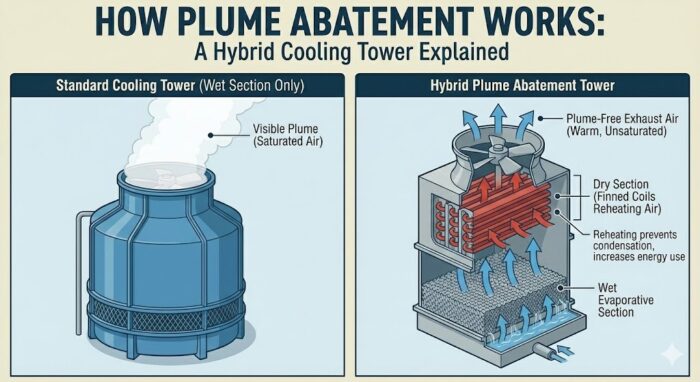
Plume abatement cooling towers are typically hybrid designs. They combine:
- A conventional wet evaporative section, and
- A dry or sensible cooling section (often finned coils)
The dry section reheats the saturated exhaust air, reducing its relative humidity so that condensation – and therefore visible plume – does not occur.
This reheating process is where the inefficiency is introduced.
The Energy and Carbon Penalty
Plume abatement does not come for free.
Increased Fan Power
Hybrid towers require higher air volumes and additional pressure drop across dry coils. This increases fan motor size and annual electricity consumption.
Larger Heat Exchange Surface
To deliver the same thermal duty, plume-abated towers are physically larger, with more steel, more fans and more parasitic energy losses.
Reduced Evaporative Effectiveness
Reheating exhaust air actively works against the thermodynamic advantage of evaporative cooling – the most energy-efficient method of heat rejection available.
Carbon Projects: The Contradiction
For carbon capture, decarbonisation or energy-reduction projects, this creates a fundamental contradiction: visible plume is removed, but electrical demand – and upstream emissions – increase.
Capital and Operational Trade-offs
Higher CAPEX
Plume-abated towers typically cost materially more than conventional induced-draft counterflow towers for the same duty.
Maintenance Complexity
Additional coils introduce fouling, cleaning and inspection requirements. Access, hygiene and long-term reliability must be engineered carefully.
Part-Load Performance
Plume abatement is most challenging in cold, part-load conditions – precisely when wet cooling towers are otherwise at their most efficient.
When Plume Abatement Is Justified
There are legitimate use cases:
- Planning conditions explicitly restrict visible plume
- Proximity to highways, rail lines or runways where fogging or icing is a proven risk
- Dense urban sites where visual impact is commercially unacceptable
In these cases, plume abatement may be unavoidable – but it should still be engineered with eyes open to the energy penalty.
When It Isn’t and Why That Matters
If plume abatement is not mandated by planning, safety or operational constraints, specifying it on sustainability grounds is usually counter-productive.
For projects claiming carbon reduction or energy optimisation – including carbon capture schemes – the most efficient solution is typically a conventional induced-draft wet cooling tower, correctly sized and controlled.
Suppressing plume to solve an aesthetic issue while increasing electrical demand is not decarbonisation. It is optics (did someone say green washing…)
Plume Abatement & Hybrid Cooling – FAQ
A stakeholder-ready checklist for planning, safety, energy, carbon, and operational performance. Use the search to quickly locate questions; expand answers for what evidence is typically expected.
Planning & Permitting
Is plume abatement mandated by planning or permit conditions?
Confirm whether plume abatement is a requirement (condition of consent/permit) or a design choice (visual/amenity mitigation).
- Review the planning decision notice and any environmental permit conditions.
- Identify the exact condition wording and measurable acceptance criteria (e.g., “no visible plume beyond boundary”).
- Record the approving authority, reference number, and required compliance evidence.
Safety & Nuisance
Is there a quantified risk of fogging or icing?
This is typically addressed through a site-specific dispersion and microclimate assessment covering visible plume, drift deposition, and low-temperature conditions that could lead to surface icing.
- Use appropriate modelling with local meteorology and geometry (see modelling methods).
- Assess receptors: roads and access routes, footpaths, loading bays, and nearby buildings/air intakes.
- Quantify likelihood and severity and document mitigations.
Energy & Performance
Has the energy penalty been modelled?
Hybrid/plume abatement solutions can introduce additional fan power, pumping, controls, or reheat/coil loads. Evidence normally includes annual energy modelling and design-point verification.
- Define baseline (see conventional wet tower baseline) and compare like-for-like duty.
- Model seasonal operation, part-load control, and winter modes (including plume abatement enable/disable logic).
- Report annual kWh, peak kW, and sensitivity to ambient conditions (see assumptions).
Carbon & Sustainability
Has whole-life carbon been assessed, not just visuals?
A robust position is a whole-life carbon (WLC) assessment: embodied carbon of additional materials plus operational emissions from energy/water/chemicals over the expected life.
- Embodied: casing/coils/extra fans, structural steel, and additional plant footprint (see embodied carbon).
- Operational: electricity, water make-up, water treatment, and plume-abatement modes (see operational carbon).
- Declare assumptions: lifetime, grid factors, and replacement schedules (see method).
Operating Envelope
Are part-load and winter conditions considered?
Decision-makers usually expect confirmation that the proposed solution remains stable and safe across the full range: minimum load, winter ambient, and transient conditions.
- Document minimum controllable fan speed, turndown, and freeze protection.
- Show winter plume behaviour and any dry-coil operation (see winter operating modes).
- Confirm water treatment controls and hygiene strategy across reduced load/temperature conditions.
Options Appraisal
Has a conventional wet tower been evaluated as a baseline?
A clear baseline improves credibility: it demonstrates whether plume abatement is proportionate versus simpler measures such as layout, discharge height, screening, or operational constraints.
- Define baseline configuration and performance (approach, range, fan power, water use, noise).
- Compare CAPEX/OPEX, risk (fog/icing), and compliance position (see options comparison).
- Provide a decision matrix with weighted criteria (see decision matrix).
Basis of Design
Are hybrid alternatives being driven by spec or evidence?
Clarify the basis for selection: mandated requirement, client preference, planning risk mitigation, or quantified operational benefits. This is typically captured in a Basis of Design (BoD).
- State the driver(s): planning condition, stakeholder concern, site constraints, or quantified risk.
- Link the choice to modelling outputs and an options appraisal (see supporting evidence).
- Document any rejected alternatives and why (space, noise, performance, cost, programme) (see options log).
Operations
Is additional maintenance budgeted and resourced?
Hybrids/plume abatement can add coils, dampers, controls, sensors, and cleaning regimes. Evidence usually includes a maintenance plan, spares strategy, and OPEX allowance.
- Identify additional tasks such as coil cleaning, drift eliminator checks, and actuator calibration.
- Confirm access, isolation, and safe maintenance (see safe access).
- Budget labour hours, consumables, downtime allowance, and critical spares holding.
Acoustics & Electrical
Are fan power and noise impacts understood?
Plume abatement arrangements can increase fan count, static pressure, and operating hours. This is typically supported by fan power calculations plus an acoustic assessment at sensitive receptors.
- Electrical: peak kW, diversity, motor starting, VSD strategy, and standby arrangements (see electrical strategy).
- Acoustics: octave-band data, tonality, nighttime criteria, and mitigation (see noise mitigation).
- Confirm that control strategy won’t push operation into non-compliant noise modes (see controls & noise limits).
Site Validation
Has a site-specific survey been completed?
Site constraints drive both plume behaviour and practicality. A site-specific survey typically covers geometry, elevations, nearby obstacles, access routes, and receptor mapping.
- Confirm available footprint, discharge height constraints, and proximity to boundaries/roads/walkways (see site constraints).
- Capture obstructions and recirculation risks such as parapets and adjacent buildings (see recirculation risk).
- Use local wind data and validate proposed locations (see wind data).