

Do you run a UK manufacturing site with cooling towers more than ten years old? If so, there is a reasonable chance they are well below their original design specification. That is not a criticism of whoever installed them. Cooling towers drift from spec gradually, in ways that rarely trigger alarms. But that drift reliably increases your energy bills and water consumption. It also raises the risk of a production constraint on the hottest day of the year. Autumn and winter, when cooling demand is low, are the best time to fix those losses before summer.
At Vistech Cooling Systems, we have surveyed hundreds of industrial cooling systems and found a consistent pattern. Engineering teams assume the system is running at roughly 90% efficiency because it appears stable. Monitoring typically reveals something closer to 72%. That gap represents recoverable energy and water savings that compound every month they go unaddressed.
Most practical interventions that bring performance back to spec, or beyond it, do not require a full tower replacement. They do require knowing where to look.
What causes airflow problems in existing cooling towers?
Airflow is the engine of an evaporative cooling tower. Thermal performance depends on drawing enough ambient air through the fill pack to sustain evaporation. When airflow drops, approach temperature rises and cooling capacity falls. The downstream process pays the price.
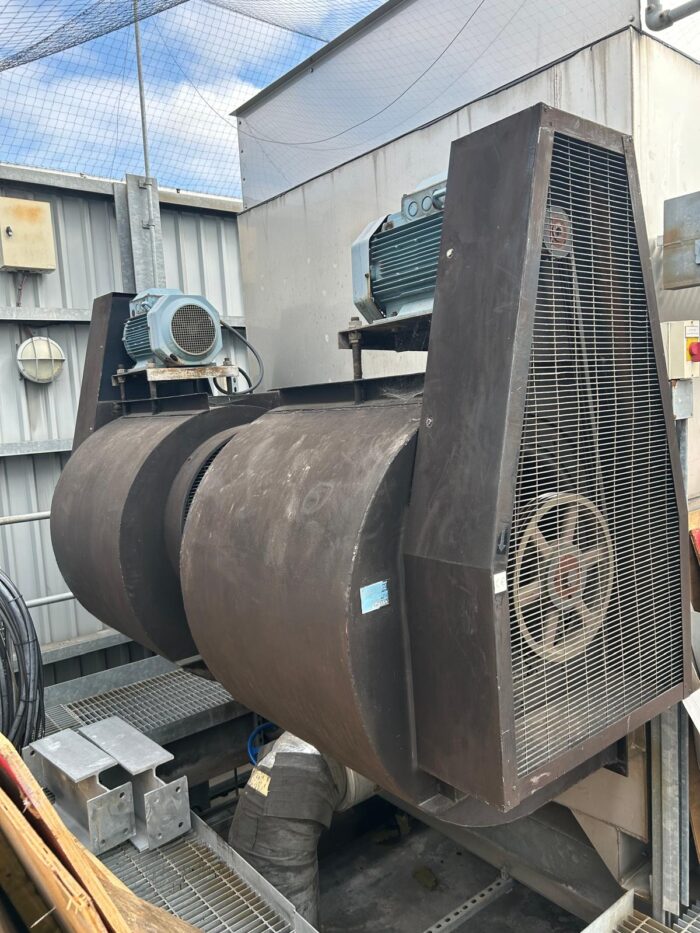
Fouled or collapsed fill media
The most common airflow restriction on an ageing tower is fouled or collapsed fill media. Fill provides the surface area where air and water interact. Over years of service, biological growth, mineral scale, and silt accumulate on those surfaces. In severe cases, deposits can reach several millimetres thick. They can increase the weight of the fill pack by a factor of ten or more. At that point, the fill is not just thermally inefficient. It is physically restricting the volume of air that can pass through the tower.
Fan blade and shroud degradation
Fan degradation is the second cause. Fibreglass-reinforced polymer (FRP) blades have a typical service life of 15 to 20 years, but deterioration starts well before that. Fraying blade edges, pitch drift, and increasing tip clearance between blade and shroud all reduce the air moved per revolution. A shroud deformed from perfectly round to slightly oblong is another problem. It reintroduces warm discharge air into the intake, directly reducing net cooling. Chemical Processing reported in March 2025 that higher-efficiency FRP fan blades can increase airflow by 15% to 30%. That comparison is against the original aluminium blades many OEMs installed to minimise upfront cost.
The fix is usually a combination of fill replacement and fan refurbishment, and the sequence matters. Replacing fill without checking the fan restores the heat transfer surface but may still starve it of air. Check the fan first: tip clearance, blade pitch, and motor condition. That gives you the baseline to evaluate what the new fill pack can actually achieve.
How does water distribution affect cooling tower thermal performance?
Water distribution is the other half of the equation. Even with clean fill and a well-maintained fan, uneven water spread leaves parts of the fill pack dry. Those dry areas contribute nothing to heat rejection.
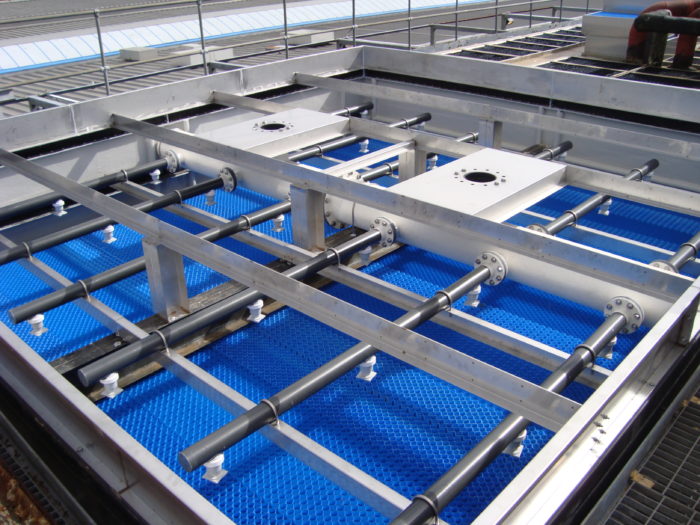
On most industrial cooling towers, the distribution system consists of a header pipe, branch pipes, and spray nozzles. Over time, nozzles clog with scale, corrosion debris, or biological matter. Header pressure drops unevenly across the bank. Some sections of fill end up flooded while others receive little or no water. On a 15-year-old tower, 20% to 30% of the fill is commonly inactive due to distribution failures.
The Cooling Tower Institute’s standard CTP-122 establishes that even water coverage is essential. Without it, the tower cannot use the full thermal potential of its fill media. When distribution degrades, approach temperature rises even if the fill itself is in reasonable condition.
Fixing distribution is often one of the highest-return interventions on an existing tower. Replace clogged nozzles, clean or replace corroded headers, and verify that spray patterns cover the full width of the fill. This can restore capacity that has been silently lost for years. Replacing packing and distribution together with high-performance alternatives has been shown to reduce cold water temperature by up to 5°C. That is a meaningful improvement for any process-critical cooling application.
Why do heat transfer bottlenecks develop over time?
Heat transfer in a cooling tower is a function of three things:
- The surface area available for evaporation (the fill)
- The volume of air moving across that surface (the fan)
- The quality of contact between air and water (distribution)
When all three are working, the tower rejects heat efficiently. When any one degrades, the others cannot fully compensate.
The difficulty is that heat transfer degradation happens slowly. Scale deposits build up at a fraction of a millimetre per month. Biological fouling colonises surfaces that water treatment may not reach. The surface area of fill packing is over 100 times that of the cooling tower casing. So treatment chemicals applied at basin level may never contact the surfaces where fouling is most consequential.
This is why approach temperature, monitored over time, is the most reliable leading indicator of heat transfer decline. Approach temperature is the difference between the cold water temperature leaving the tower and the ambient wet bulb temperature. Watch for a rising approach that correlates with production load rather than ambient conditions. That points to fill fouling, distribution failure, or both.
Modern high-performance fill designs offer a practical upgrade path. Modular block packing, for example, delivers better thermal performance per unit volume than older hanging sheet fill. Block packing is also structurally self-supporting. That eliminates the sag and stretching that plague ageing hanging sheet installations. The modular design simplifies future cleaning and replacement, reducing the long-term maintenance burden.
When should you retrofit rather than replace the entire tower?
On many manufacturing sites, the instinct is to request a replacement when cooling performance drops. But a full tower replacement is a significant capital project. It typically involves months of lead time, structural work, and production disruption. In many cases, a targeted retrofit delivers comparable improvement at a fraction of the cost and downtime.
Retrofit makes most sense when the tower structure, whether steel, concrete, or GRP, is still sound. If the casing, basin, and structural frame are intact, the problem almost certainly lies in four areas. Those are the fill, the distribution system, the fan assembly, and the controls. All four can be addressed without removing the tower.
The case for retrofit is strongest in two situations. First, the tower may have been oversized for today’s cooling load, because process requirements have changed. Second, the original equipment may have used economy-grade components. Many OEMs install the cheapest fan and fill options to maximise margin on the initial sale. Upgrading those components to higher-specification alternatives can take the tower beyond its original design capacity.
One important caveat: retrofit decisions should be based on measured data, not assumptions. A performance survey captures supply and return temperatures, flow rates, fan power consumption, and ambient conditions under real production loads. That provides the evidence base for choosing interventions with a quantifiable return. Without that data, there is a risk of solving symptoms rather than system causes.
How do fan and motor upgrades reduce energy consumption?
Fan energy is typically the single largest operating cost of a cooling tower. On a conventional fixed-speed installation, the fan runs at full output whatever the cooling demand. On a mild spring day, that means paying for airflow you do not need.
Variable speed drives and motor selection
Variable speed drives (VSDs) address this directly by modulating fan speed to match actual cooling demand. That cuts energy use during partial-load conditions, which make up most operating hours on most UK manufacturing sites. The saving follows the fan affinity laws: halving fan speed reduces power consumption to roughly one-eighth. In practice, intelligent controls modulate fan speed and spray setpoints based on real-time demand. They can reduce cooling system energy consumption by 20% to 30% or more, depending on existing operation and load profile.
Motor selection matters as well. On its own, upgrading from a standard-efficiency to a high-efficiency motor delivers a modest 1% to 5% saving. Combined with a VSD and a right-sized motor, though, the compound effect is substantial. The motor upgrade rarely justifies the project alone. As part of a broader controls and mechanical retrofit, it contributes meaningfully to lower total cost of ownership.
Smart controls
Smart control systems add a further layer beyond simple VSD modulation. They can schedule fan operation to manage noise compliance. They also provide predictive fault diagnosis through continuous sensor monitoring, and enable remote access to operational data. Some sites are limited by noise rather than equipment. For them, scheduling higher fan speeds during daytime production and lower speeds overnight can unlock previously unavailable capacity.
What role does system-level thinking play in cooling tower performance?
The most common mistake in cooling tower optimisation is treating the tower as an isolated component. A cooling tower is part of a system that includes pumps, pipework, control valves, and the process loads it serves. Improving the tower while ignoring the system around it often delivers disappointing results.
Fixed-speed pumps working against throttled control valves are a frequent source of instability in industrial cooling circuits. The pump delivers constant flow regardless of how many process loads are calling for cooling. When demand drops, the control valves throttle, back-pressure increases, and energy is wasted. When demand spikes, multiple loads open at once and differential pressure collapses. No single process then gets adequate cooling. This is a system design problem, not a tower problem. No amount of fill replacement will fix it.
The practical fix is to evaluate the cooling circuit as a whole. That means variable speed pumping matched to real demand, and correctly sized pipework. It also means a control philosophy that prioritises stable system pressure over individual valve position. Together, these can deliver energy savings that exceed the tower-side improvements alone.
At Vistech, we approach cooling system performance from the process backwards. The tower is a critical component, but the engineering starts with what the process actually needs. What temperature, at what flow, with what degree of resilience? We work from that requirement forward through pumps, controls, and distribution to the tower itself. That is how you avoid optimising one component while the system around it wastes the gains.
How do you find where cooling tower performance is being lost?
Cooling tower performance on an existing manufacturing site is rarely limited by a single cause. Airflow, water distribution, heat transfer surfaces, controls, and the wider hydraulic circuit all contribute. The practical approach is to measure first and identify where the largest losses are hiding. Then target interventions where the return is quantifiable.
Your system may have evolved over years of incremental changes, leaving you unsure where performance is being lost. If so, a structured performance survey is the fastest route to clarity. Vistech’s approach starts with a system health check and performance monitoring study. This establishes a verified baseline before we recommend any capital investment. We only recommend progression where measurable opportunity exists, and we guarantee it. If no efficiency improvement is identified, the assessment cost is refunded.
For UK manufacturing sites with cooling loads above 500kW, that conversation starts with a single site visit. Contact the Vistech team to arrange yours.