

Cooling tower warning signs usually appear long before a tower needs urgent repair. Every tower reaches a point where it stops being “old but fine” and becomes a maintenance emergency. What surprises most people is how predictable that moment is. The signs sit in the fill pack, the basin, the nozzle pattern and the fan vibration data for months. Sometimes they sit there for years before anyone writes them down.
The reason they go unrecorded is rarely negligence. Cooling towers are the Cinderella of the plant. They are out of sight, often on the roof or behind the process hall, and nobody gets promoted for reporting on a tower that keeps working. So the tower gets walked past on a monthly route and the checklist gets a tick. Meanwhile, the gradual loss of heat transfer disappears into the energy bill, where nobody attributes it to anything.
That is precisely why a structured condition assessment matters before refurbishment becomes urgent. When you decide from documented evidence rather than an emergency call-out, the outcome changes. The scope of work is right, the budget is defensible, and the tower returns to design performance instead of “better than it was”. At Vistech Cooling Systems, we have refurbished hundreds of towers across UK industrial sites. The projects that go best are always the ones where the client arrives with their own findings already documented.
What does a proper cooling tower condition assessment cover?
A condition assessment is not a perimeter walk with a clipboard. Instead, it is a structured examination of every component that transfers heat or keeps water where it should be. Each component fails in its own way, and each produces its own cooling tower warning signs.
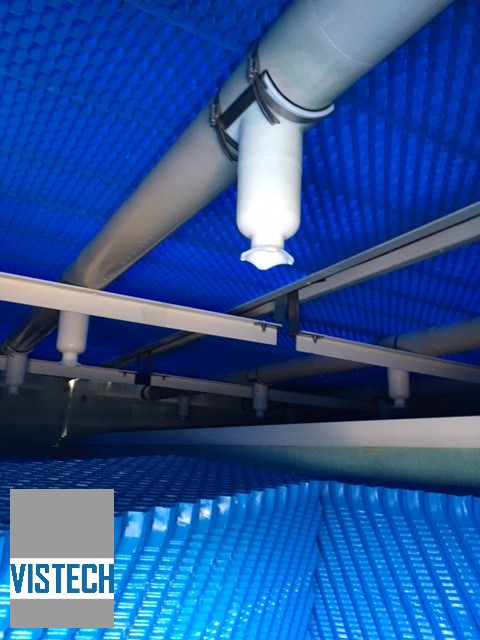
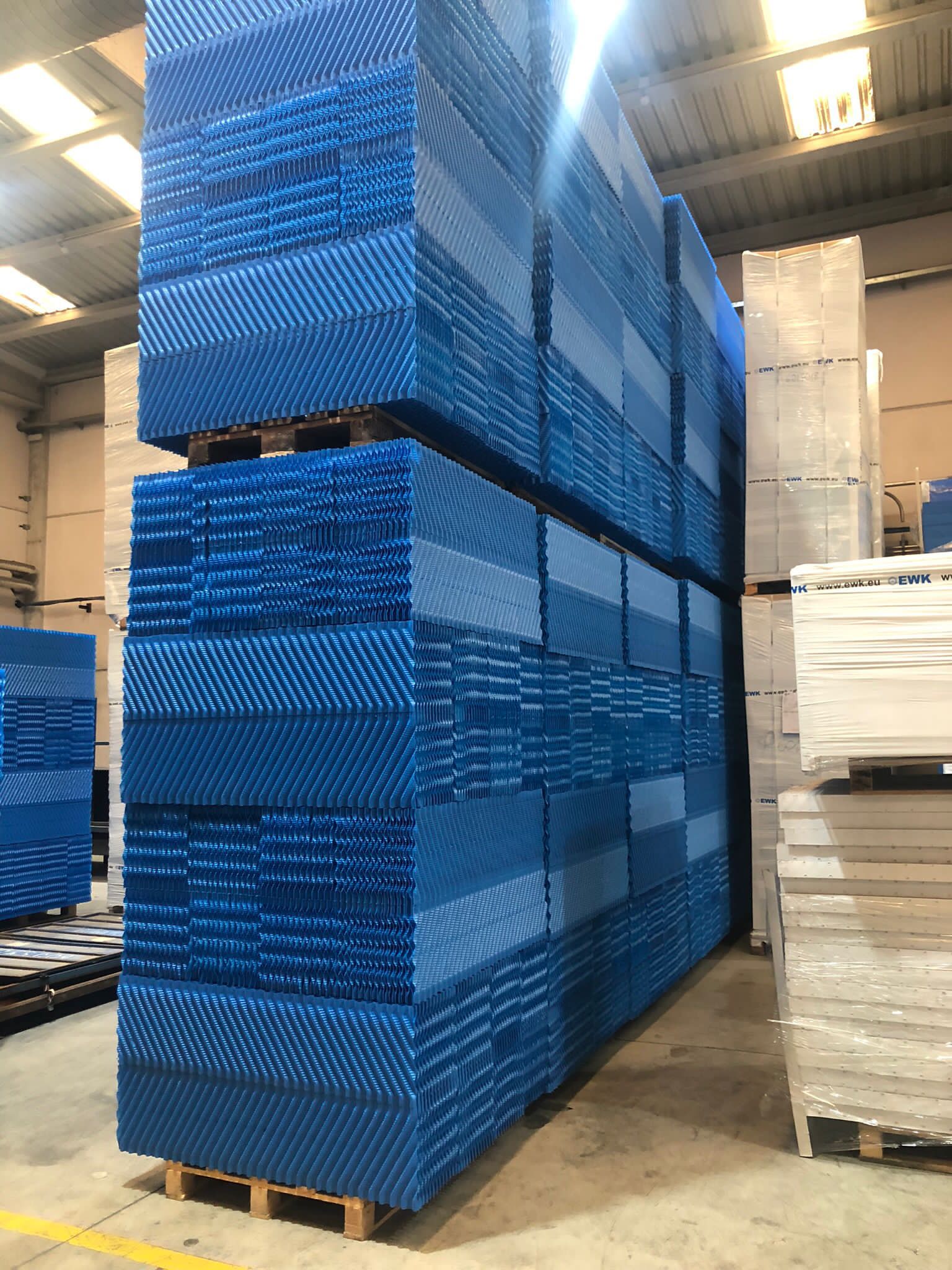
Start with the fill pack, because it does the thermal work. Inspect it for scale build-up, fouling, brittleness and warping. Also check that the fill sheets are still evenly aligned and spaced. Misaligned fill distributes water unevenly. This shows up as dry spots and hot spots that quietly cut your heat transfer area. On older modular packs, check whether the pack still holds its shape or has sagged into the sump below. That is a mechanical problem as much as a thermal one.
Next, look at the water distribution system. Clogged or misdirected nozzles are one of the most common root causes of declining tower performance. They are also one of the cheapest to correct. That makes them exactly the kind of finding you want to surface early, before the tower gets blamed for a chiller problem it never caused.
Structure and mechanical train
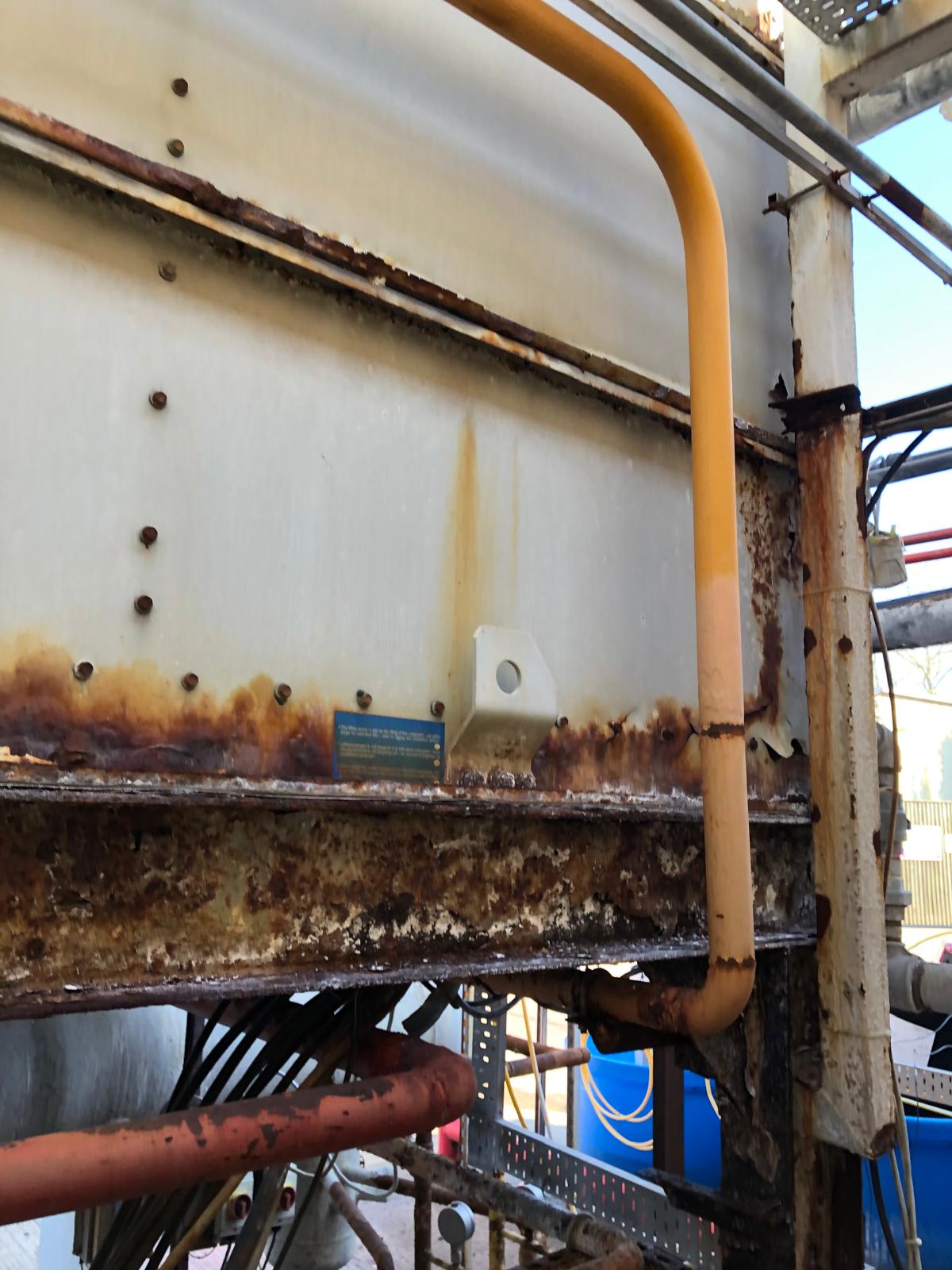
Then move on to the structure. On a steel tower, look for corrosion at welded and bolted joints, where galvanised protection tends to fail first. Check the basin for leaks and sediment. On casing materials, look for cracks, loose fasteners and panel degradation. Finally, assess the mechanical train: bearings, gearbox, drive alignment and fan assembly. Judge them by noise, vibration and condition under load, not by eye alone.
The aim of all this is simple. A condition assessment gives you a documented picture of the tower’s actual state. So when someone asks “how long has this got left?”, you have evidence instead of an opinion.
Which cooling tower warning signs point to refurbishment?
Most of what gets called a cooling tower repair is a component fix: a bearing, a nozzle, a seal or a drift eliminator blade. Those fixes matter, but they address symptoms. Refurbishment becomes the right conversation when wear reaches the parts that define thermal performance or structure. A recognisable pattern of signs takes you there.
The clearest of the cooling tower warning signs is fill pack degradation. Scale, fouling and sagging reduce the effective heat transfer surface. As a result, chillers and process equipment work harder for the same cooling. Has your approach temperature drifted upward over a season? Has utility consumption crept up without a change in load? If so, the fill is a likely suspect, and it will not recover on its own.
The key distinction is this. Fouling you can clean is a maintenance task. Fill that has degraded in structure is a refurbishment item.
Uneven airflow is the second strong signal. Damaged or missing drift eliminators, fouled fill and degraded casing all disrupt the air path. The tower compensates by moving more air than it should, which shows up as rising fan energy. Similarly, persistent corrosion and basin deterioration on older steel towers push you the same way. At that point you are no longer deciding about performance. You are deciding about integrity.
Age and the like-for-like question
Age sets the frame for all of it. Towers are long-life assets, typically giving 20 to 25 years of service. Most industrial sites are therefore running equipment that has already been refurbished once. Others still carry original components at the end of their practical life.
That is why it pays to pause before defaulting to a phrase we hear constantly: “please may we have a like-for-like replacement”. Like-for-like may be right. However, a tower that is likely to be a quarter of a century old deserves a closer look first. A condition assessment will usually show one of two things. Either refurbishment restores performance for a fraction of the capital, or process loads have moved on so far that like-for-like is the wrong scope. Both answers are legitimate. The point is to reach them with data rather than habit.
Which cooling tower warning signs show up in the water?
Some of the strongest cooling tower warning signs never require an internal inspection. They are already flowing through your water treatment records and your utility meter.
Rising water consumption is the first sign. When fill fouls, nozzles block or drift eliminators degrade, the tower uses more water for the same cooling duty. In effect, the water bill becomes an indirect condition monitor. The trend matters more than any single reading.

Water chemistry and compliance
Water chemistry is the second sign. Scale formation and biological growth both degrade heat transfer. Both also appear in your treatment records before they are visible on the fill.
There is a compliance dimension here too. Under HSE guidance, routine sampling for open systems such as cooling towers should take place at least quarterly. A UKAS-accredited laboratory should test the samples. You should then interpret the results in the context of your own control regime.
The second edition of HSG274 Part 1, published in 2024, also sharpened the guidance on DPD No 1 test methodology. In addition, it clarified how cooling water pH affects halogen biocides such as chlorine and bromine. As a result, historic test records may need pH correction before you compare them against current control limits.
This matters for practical reasons as well as safety ones. Legionella control under ACOP L8 requires a documented risk assessment, a control scheme and records of your precautions. A tower that scales, fouls and uses more water each quarter is drifting outside its control regime, and your records will show it. In other words, the documentation that keeps you compliant is also your earliest warning of thermal decline.
How do you choose between refurbishment and replacement?
Once the assessment is documented, the choice between refurbishment and replacement becomes a real comparison. It is no longer a debate between opinions. Three inputs drive it.
The first input is the condition picture itself. Which components have degraded, and how far? Are the failure mechanisms isolated or systemic? Widespread structural corrosion on a steel frame points one way. Fouled fill on a structurally sound tower points another. Modern fill and drift eliminator technology has also moved on a long way since most towers were built. For that reason, refurbishment often improves performance as well as repairing the tower.
The second input is energy. A tower losing heat transfer efficiency forces the connected plant to work harder, and that cost builds every day. Comparing measured performance against modelled post-refurbishment performance turns the decision into numbers. That is why we treat the performance survey, part of our Efficiency Review, as the front door to every refurbishment project. It gives you evidence for your own CAPEX approval. It also guards against oversizing before you commit to any work.
The wider system
The third input is the wider system, and this is where component thinking costs money. A tower does not operate alone. Pump configuration, control valves, fan control and the process demand profile all shape whether the system meets the load efficiently. Assessing the tower in isolation risks refurbishing it into a system that still underperforms. So on a full refurbishment, we review the hydraulic design and control philosophy alongside the tower. Extending asset life only counts if the system around it also runs efficiently.
Weigh all three and the right answer usually becomes clear. It will not always be refurbishment, and it will not always be replacement. There is no universal answer, only the right scope for your tower, your process loads and your budget horizon. In every case, though, you can reach an answer based on evidence.
How should you record cooling tower warning signs?
Documentation turns an inspection from an opinion into an asset. The findings worth recording are the ones that change over time:
- Approach temperature trends
- Water consumption trends
- Vibration readings on the mechanical train
- Condition of the fill, nozzles, drift eliminators and structural steel
- Dated photographs of each of the above
A baseline photograph of your fill pack today is the cheapest tool you have for judging its rate of decline two years from now.

Under ACOP L8, record-keeping is not optional. Dutyholders must keep records of the precautions they have put in place. In practice, the strongest records do double duty. First, they show compliance to an inspector or insurer. Second, they build the business case for refurbishment by showing a documented trend rather than a sudden crisis.
Picture presenting a tower to the board like this: “Our quarterly records show approach temperature drifting upward for six consecutive quarters, alongside a measurable rise in water consumption.” With that evidence, capital approval becomes a much easier conversation.
There is also a timing argument. Refurbishment is best scheduled around planned production windows. Planned work is cheaper, safer and better executed than urgent work. Every quarter without documented condition data is a quarter in which the decision deadline arrives on someone else’s terms.
Act on cooling tower warning signs before they become urgent
A condition assessment is ultimately a habit, not an event. Towers fail slowly and then suddenly. The interval between the two is exactly where your inspection programme should live.
Would you like a structured survey of your existing towers? Or a benchmark conversation about whether refurbishment is the right scope for your site? Contact our team at Vistech Cooling Systems. We are happy to walk the plant with you and put the findings in writing. Control what you can control, and the condition of your cooling infrastructure is one of those things.