
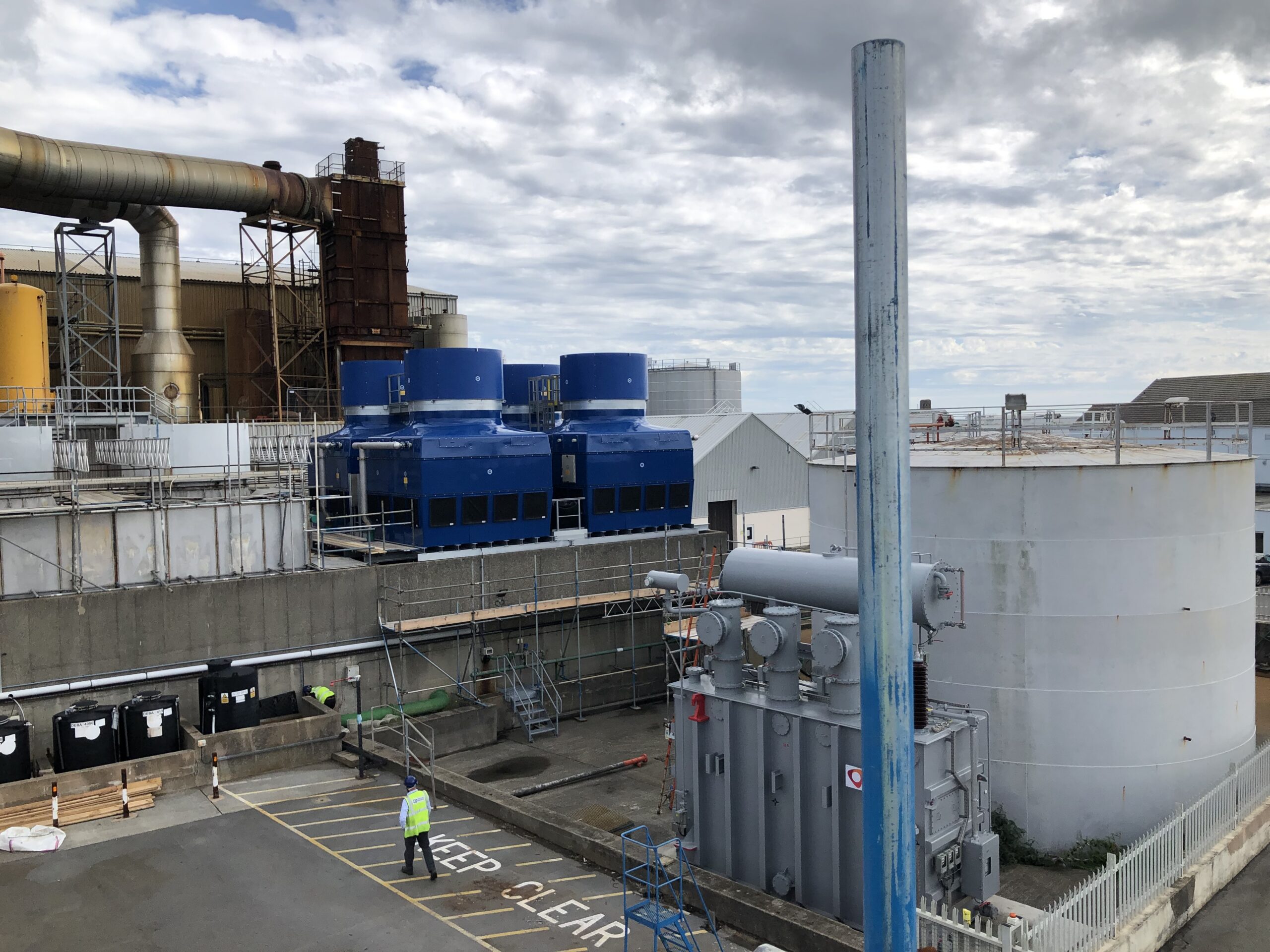
Evaporative cooling towers remain a critical part of UK manufacturing infrastructure. They support process cooling, production reliability, energy efficiency and regulatory compliance across a wide range of industrial sites.
But the decisions surrounding cooling towers have changed.
In 2026, manufacturers are not only asking whether a cooling tower can meet the required heat rejection duty. They are also asking whether the existing cooling strategy is still appropriate for today’s energy costs, water pressures, compliance expectations, production profile and long-term site plans.
Many cooling systems currently operating across UK manufacturing sites were installed 15, 20 or even 30 years ago. Since then, the site around them may have changed significantly. Production volumes may have increased. Processes may have been modified. Buildings may have been extended. Access routes may have become restricted. Water treatment requirements may have changed. Energy prices have become a much larger operational concern. Water resilience has moved higher up the agenda.
For that reason, cooling tower replacement or refurbishment should not be treated as a simple like-for-like purchasing exercise. It should be treated as an opportunity to review whether the existing cooling system is still fit for purpose.
A well-selected evaporative cooling system can still offer one of the most efficient ways of rejecting large industrial heat loads. However, the right answer may not always be a traditional open cooling tower, and it may not always be a full replacement. Depending on the site, the best solution may involve refurbishment, upgraded controls, variable speed drives, improved packing, better water treatment, side-stream filtration, a closed circuit system, an adiabatic cooler, a hybrid solution or a full redesign.
The key is to assess the full system, not just the tower.
Why Cooling Tower Decisions Matter More in 2026
For UK manufacturers, cooling infrastructure now sits at the intersection of four major pressures: energy cost, water availability, compliance risk and production resilience.
Energy is no longer a background utility cost that can be accepted as fixed. Make UK has reported that UK industrial electricity prices are “four times higher than in the US and 46% above the global average”. Against that backdrop, every large item of rotating plant, every fan, every pump, every chiller and every inefficient control strategy deserves closer attention.
Water availability is also becoming a more important operational and strategic issue. The Environment Agency has warned that England could face a “5 billion litre a day shortfall” in public water supplies by 2055, with additional pressure on the wider economy. The House of Commons Library has also referred to a projected shortfall of nearly 5 billion litres per day by 2050, equivalent to “over a third of the current water supply available for public consumption”.
This does not mean evaporative cooling is no longer appropriate. In many industrial applications, it remains one of the most efficient ways to reject large heat loads. However, it does mean that water consumption, blowdown, drift, discharge limits, cycles of concentration and alternative cooling strategies should be considered more carefully than they may have been in the past.
Compliance expectations are also more visible. ACOP L8 and HSG 274 Part 1 require cooling systems to be properly risk assessed, controlled, monitored, cleaned, maintained and documented. A system that is difficult to access, inspect, clean or understand is not just an operational inconvenience. It can become a compliance and business continuity risk.
For these reasons, cooling tower replacement or refurbishment should not begin with the question:
“What did we have before?”
It should begin with:
“What does the site actually need now?”
Legacy Cooling Systems Were Designed on Assumptions
Many existing cooling systems were designed around assumptions.
They may have been reasonable assumptions at the time, but they were still assumptions.
The original design may have assumed a certain production output, a certain heat load, a certain process temperature, a certain operating pattern, a certain wet bulb design condition, a certain water quality, a certain energy cost, a certain maintenance regime and a certain site layout.
In many cases, those assumptions are now out of date.
Production may have increased. Processes may have changed. Equipment may have been replaced. New lines may have been added. Old loads may have been removed. Pumps may have been changed. Pipework may have been modified. Control valves may have been adjusted over time to compensate for operational issues. Buildings may have been extended around the plant. Access may have become more restricted. Noise constraints may have changed. Water treatment requirements may be different. The site may now operate longer hours, different shifts or more variable production cycles.
The cooling tower may still be operating, but that does not mean the system is still right.
This is why like-for-like replacement can be a missed opportunity. It risks preserving design decisions that were based on historic assumptions rather than current evidence.
A proper review should establish the actual duty, actual flow rates, actual temperatures, actual operating hours, actual site constraints and actual future requirements. Only then can a manufacturer decide whether the right answer is replacement, refurbishment, controls optimisation, pump upgrades, improved water treatment, adiabatic cooling, hybrid cooling or a full redesign.
The key point is simple:
The existing system should be treated as evidence, not as the specification.
What Are Evaporative Cooling Towers?
An evaporative cooling tower removes heat from water by bringing warm water into contact with air. As a small portion of the water evaporates, heat is removed from the remaining water and discharged into the atmosphere.
In a typical open circuit tower, warm process water is distributed over fill packing. The fill increases the contact area between water and air, improving heat transfer. Fans either draw or push air through the tower, supporting evaporation and removing heat from the system.
The performance of an evaporative cooling tower is linked to wet bulb temperature rather than dry bulb temperature. This matters because evaporative systems can cool water below the ambient dry bulb temperature, which dry cooling alone cannot achieve.
That is why evaporative cooling remains so effective for many industrial applications. It can provide reliable cooling performance with comparatively low energy consumption, particularly where large heat loads need to be rejected continuously.
Water Consumption and System Losses
Evaporative cooling uses water because evaporation is the mechanism that removes heat. That is not a weakness in the technology; it is the principle that makes it efficient.
However, water use now needs to be assessed more strategically.
Water losses occur through three main routes: evaporation, drift and blowdown.
Evaporation is the useful part of the process. It is the heat rejection mechanism.
Drift is the loss of small water droplets carried out of the tower with the discharge air. Modern drift eliminators are designed to minimise this, but they need to be correctly specified, installed, inspected and maintained.
Blowdown is the controlled removal of water from the system to manage dissolved solids and maintain suitable water chemistry. The required blowdown rate depends on makeup water quality, cycles of concentration, treatment regime and discharge requirements.
Manufacturers should review whether their existing system is using water efficiently. That includes checking cycles of concentration, water treatment performance, leakage, overflow, drift eliminator condition, basin condition, side-stream filtration options and whether the system is operating within its intended control range.
The objective is not simply to reduce water at any cost. It is to achieve the right balance between water use, energy consumption, compliance, process reliability and whole-life value.
Open Circuit Cooling Towers
Open circuit cooling towers expose the process water directly to air. Warm water is distributed over fill packing, air passes through the tower, and a proportion of the water evaporates, removing heat from the remaining water.
This is usually the most thermally efficient form of evaporative cooling because there is no intermediate heat exchanger between the process water and the air.
Open circuit systems can offer low approach temperatures, efficient operation and relatively compact equipment. They are well suited to applications where the process water can be treated and circulated through an open evaporative system.
However, they require robust water treatment, drift control, safe access, cleaning, monitoring and Legionella risk management.
For many manufacturing sites, open circuit cooling remains the most efficient and practical option. The important point is to verify that it is appropriate for the current process, current water strategy and current compliance expectations.
Closed Circuit Cooling Towers
Closed circuit cooling towers keep the process fluid inside a coil or tube bundle. A separate spray water circuit wets the outside of the coil, while air passes across it to remove heat.
This protects the process fluid from direct atmospheric exposure. Closed circuit systems can be valuable where the process fluid contains glycol, corrosion inhibitors or specialist additives, or where contamination of the process circuit must be avoided.
The trade-off is that closed circuit towers are generally larger, more complex and more expensive than open circuit towers for the same duty. They can also require more fan power because air must pass across the coil section.
Closed circuit systems can be the right solution, but they should be selected because the application requires separation, not simply because the existing system is already closed circuit.
Adiabatic Coolers
Adiabatic cooling is becoming increasingly relevant where water reduction is a priority.
An adiabatic cooler generally operates dry for much of the year. During warmer conditions, water is introduced to pre-cool the air or assist heat rejection. This can significantly reduce annual water consumption compared with a continuously wet evaporative cooling tower.
A correctly designed adiabatic system can be selected to meet the required cooling duty. The assessment should therefore focus on the full engineering and commercial picture: annual water use, fan energy, footprint, capital cost, controls, maintenance requirements, site constraints and whole-life value.
Adiabatic cooling should not be seen as a universal replacement for evaporative cooling. It should be considered as part of a properly engineered options appraisal.
For some sites, adiabatic cooling may provide the right balance of water reduction, performance and operational resilience. For others, a conventional evaporative tower, closed circuit tower or hybrid approach may offer the better lifecycle outcome.
Hybrid Cooling Systems
Hybrid cooling systems combine dry and evaporative cooling principles.
They can reduce water consumption compared with fully evaporative systems while still providing additional cooling capacity during warmer periods. They may also be useful where plume reduction, water use, energy cost and production resilience all need to be considered together.
Hybrid systems can be effective, but they should be selected carefully. The right design depends on actual heat load, operating hours, seasonal ambient conditions, water availability, energy cost and site-specific requirements.
As with all cooling technologies, the best solution is the one that is properly matched to the site.
Cooling Tower Configuration
Cooling tower terminology can become overcomplicated. For most manufacturing clients, the most important question is whether the system should be open circuit, closed circuit, adiabatic or hybrid.
Once that strategic decision is made, the mechanical configuration can be selected.
In a counter-flow tower, air moves upward through the fill while water flows downward. This arrangement offers efficient heat transfer and is commonly used where compact footprint and strong thermal performance are priorities.
In a cross-flow tower, air moves horizontally across the fill while water flows downward. Cross-flow towers can offer good access to the water distribution system and fill, which may support maintenance.
In an induced draft tower, fans are generally located at the discharge side of the unit and draw air through the tower.
In a forced draft tower, fans are positioned to push air into the tower. This can improve access to mechanical components but requires careful design to avoid recirculation.
The configuration should be selected around duty, footprint, airflow, maintenance access, noise, plume, structural constraints and site layout.
Steel and GRP Cooling Towers
Material selection has a direct impact on cooling tower lifecycle, corrosion resistance, structural loading and maintenance requirements.
Steel cooling towers have been widely used across industry for many years. Galvanised steel can provide good corrosion resistance in moderate environments, while stainless steel may be appropriate for more aggressive applications or specific project requirements.
Steel offers strong mechanical performance and may be required where fire rating, structural loading or specification standards dictate its use.
The main limitation is corrosion risk. Cooling towers operate in wet, chemically treated and often aggressive environments. Over time, coatings and galvanised finishes degrade, and maintenance requirements can increase.
GRP, or glass reinforced plastic, is widely used in cooling tower construction because of its corrosion resistance and relatively low weight. It can be particularly attractive in coastal, chemical or aggressive industrial environments where corrosion is a significant lifecycle concern.
The lighter structure can also be useful on refurbishment projects where existing foundations, roof structures or steelwork have limited spare capacity.
GRP is not automatically the right choice for every application, just as steel is not automatically the wrong one. The correct material should be selected based on environment, duty, structure, fire requirements, access, maintenance and lifecycle cost.
ACOP L8 and Legionella Compliance
Cooling towers are subject to strict Legionella control requirements in the UK.
ACOP L8 sets out how duty holders should manage the risk of exposure to Legionella bacteria. HSG 274 Part 1 provides technical guidance for evaporative cooling systems, including design, operation, monitoring, inspection, cleaning and maintenance.
A duty holder must identify and assess Legionella risk, prepare a written scheme of control, implement suitable control measures, monitor performance, keep records and ensure that competent people are appointed to manage the system.
This responsibility cannot simply be passed to a contractor. Specialist contractors can support compliance, but the duty holder remains accountable for ensuring that the system is properly managed.
This is another reason why ageing infrastructure needs careful review. A cooling tower that is difficult to access, inspect, clean or maintain is harder to manage effectively. Compliance is not just about paperwork. It is about whether the system can be properly controlled in practice.
Legionella Risk Assessment
A Legionella risk assessment should be specific to the actual system. It should not be a generic document.
For cooling towers, the assessment should consider system design, hydraulics, water treatment, operating temperatures, areas of poor circulation, drift eliminators, access arrangements, cleaning provisions, maintenance history, monitoring records and the condition of key components.
Cooling towers present risk because they operate with warm water and can generate aerosols. Legionella bacteria can multiply where water treatment is ineffective, surfaces are fouled, temperatures are favourable or stagnant areas exist.
An effective risk assessment should identify hazards, evaluate existing controls, highlight deficiencies and provide a practical action plan. It should be reviewed regularly and whenever the system, use, operation or risk profile changes.
Written Scheme of Control
A written scheme of control sets out how Legionella risk will be prevented or controlled.
For cooling towers, this should include clear arrangements for water treatment, chemical dosing, microbiological monitoring, cleaning and disinfection, inspection of drift eliminators, maintenance of fill and nozzles, basin cleaning, safe access, record keeping, responsibilities and escalation procedures.
The scheme must be practical, site-specific and actively managed. Documentation alone is not sufficient. The control measures must be implemented consistently and reviewed against monitoring results.
If the system has changed over time, or if the cooling tower no longer reflects the way the site operates, the written scheme should be reviewed accordingly.
Energy Efficiency Opportunities
Energy efficiency is now one of the strongest reasons to reassess cooling infrastructure.
Cooling tower energy use is not limited to the fan. The wider system may include pumps, control valves, chillers, heat exchangers, water treatment equipment, sensors and control logic.
In many legacy systems, these elements have evolved over time without being reviewed as one integrated system.
Common issues include constant-speed fans running when full airflow is not required, pumps sized for historic duties rather than current operation, control valves used to compensate for poor hydraulic balance, fouled fill packing reducing heat transfer efficiency, poor spray distribution, inadequate control based on wet bulb temperature and chillers operating harder because cooling water temperatures are higher than necessary.
Variable speed drives, modern controls, improved packing, better water distribution, system balancing and better monitoring can often reduce energy consumption without replacing the entire cooling system.
The greatest savings are often found by looking beyond the tower itself. If improved cooling tower performance allows a process chiller, compressor, hydraulic system or production process to operate more efficiently, the wider energy benefit can be greater than the tower fan saving alone.
Water Scarcity and Cooling Strategy
Water use is becoming a more important part of cooling strategy.
Evaporative cooling consumes water by design, but it can also reduce electricity consumption significantly compared with dry cooling alternatives. The best solution is therefore not always the one that uses the least water or the least energy in isolation.
The right question is:
How can the site achieve the required cooling duty with the best balance of water use, energy consumption, compliance, reliability and lifecycle cost?
Manufacturers should review evaporation losses, blowdown volumes, cycles of concentration, makeup water quality, discharge limits, drift eliminator condition, water treatment performance, side-stream filtration opportunities and whether any uncontrolled losses are occurring.
For some sites, the answer may be to retain evaporative cooling but improve water treatment, filtration, drift control, monitoring and controls.
For others, adiabatic or hybrid cooling may provide a better long-term balance.
The point is not to assume that one technology is automatically better than another. The point is to evaluate the options against the site’s actual requirements.
From Assumption to Evidence
The most effective cooling projects start with evidence.
Before specifying new equipment, manufacturers should understand how the existing system is actually performing. That means reviewing current heat load, flow rates, temperatures, pump operation, fan control, water treatment regime, maintenance access, compliance records and the condition of key components such as fill packing, drift eliminators, nozzles, basins and distribution systems.
This is where an engineering-led review can add real value.
Vistech Cooling Systems supports clients through efficiency reviews, discovery studies and full Front-End Engineering Design packages. These services help manufacturers move from assumption to evidence before committing capital.
An efficiency review can identify immediate opportunities to reduce energy consumption, improve heat transfer, reduce unnecessary water loss or address operational risks.
A discovery study can help establish whether the existing cooling strategy is still suitable for the current site, or whether alternative approaches should be considered.
A FEED package can take this further by developing the technical design, layout, equipment specification, performance expectations, project scope, budget and delivery strategy before procurement or installation begins.
The purpose is not to make the project more complicated. It is to make sure the client gets what they actually need.
For some sites, that may be a refurbished evaporative cooling tower with upgraded packing, drift eliminators, access and controls. For others, it may be a new open circuit tower, a closed circuit tower, an adiabatic cooler, a hybrid system or a wider cooling system redesign.
The right solution should be based on current data, future requirements and whole-life value, not on assumptions made when the original system was installed.
Refurbishment, Upgrade or Replacement?
Not every site needs a full cooling tower replacement.
Where the tower structure remains sound, refurbishment may extend asset life and improve performance. This can include replacement fill, drift eliminators, spray nozzles, fans, motors, access platforms, basins or casing components.
Where the cooling tower is thermally suitable but operating inefficiently, controls upgrades may offer a better return than replacement. Variable speed drives, improved sensors and control logic based on actual demand can reduce energy consumption during part-load operation.
Where fouling, water quality or blowdown are the main issues, water treatment improvements, filtration or monitoring upgrades may provide the most value.
Where the existing tower is structurally poor, inefficient, non-compliant, inaccessible or fundamentally unsuitable for the current duty, full replacement may be the correct route.
The important point is that the decision should follow the evidence.
Selecting a Replacement Cooling System
Where replacement is required, the new system should be selected around the site’s current and future needs.
A proper review should consider current process heat load, future production plans, required flow rates, required temperatures, peak summer operating conditions, wet bulb and dry bulb design data, site water availability, energy cost exposure, compliance requirements, noise constraints, plume considerations, maintenance access, structural limitations, available footprint, installation phasing and business interruption risk.
Oversizing can waste capital and increase operating costs. Undersizing can restrict production and reduce resilience during warm weather.
The aim is to right-size the cooling strategy based on actual data and realistic future requirements.
Commissioning and Handover
A new or refurbished cooling system should be properly commissioned before being handed over for operation.
Pre-commissioning checks should include inspection of construction quality, basin cleanliness, drift eliminator installation, nozzle orientation, fill condition, fan rotation, mechanical components, pipework cleanliness and water treatment readiness.
Performance should be verified using measured flow rate, inlet and outlet water temperatures and ambient conditions. This provides evidence that the system is achieving the intended duty.
Handover should include operation and maintenance manuals, commissioning records, as-built drawings, training, water treatment information, maintenance requirements and any updates required to the Legionella risk assessment and written scheme of control.
A cooling system should not only be installed correctly. It should be handed over in a condition that allows it to be operated, maintained and managed properly.
Conclusion
In 2026, evaporative cooling tower decisions should be made in the context of energy cost, water resilience, compliance and changing manufacturing requirements.
Many legacy systems were installed for sites that no longer operate in the same way. Production demands may have changed, energy costs have increased, water use is under greater scrutiny and compliance expectations are more demanding.
That creates both risk and opportunity.
The risk is that manufacturers continue to operate or replace cooling systems based on outdated assumptions.
The opportunity is to reassess the full system and identify a better solution for today’s site.
For some facilities, the right answer will be a more efficient open circuit evaporative cooling tower. For others, it may be a closed circuit design, a refurbishment, an adiabatic cooler, a hybrid system or a controls-led optimisation project.
The most important step is to avoid treating cooling infrastructure as a like-for-like replacement exercise.
A cooling system should be selected, maintained and optimised around the site’s actual duty, current operating conditions, water strategy, energy exposure, compliance requirements and future production plans.
For UK manufacturers, the question is no longer simply:
“What cooling tower do we need?”
The better question is:
“What cooling strategy is right for this site now, and for the years ahead?”